zondag 22 februari 2009

Back and Forth: Spectacular Nature


Most chemical reactions proceed via a reactive intermediary state of which the concentration increases to a maximum and drops to zero during the course of the reaction.
Interestingly, a few reactions have been studied that do not share this common behaviour but rather have oscillating concentrations of the intermediates.
For example, in the 1950’s the Russian chemists Belousov and Zhabotinski discovered and studied a reaction which currently is known as the reaction between the bromate cation and malonic acid which, catalyzed by a cerium (III-IV) redox couple, are transformed into bromomalonic acid and carbondioxide.
Adding a ferroin indicator to the reaction medium will visualize a remarkable phenomenon; through a complex feedback reaction characterized by accumulation and induction, the colour of the solution will strikingly oscillate from blue to red and back.
Another oscillating chemical reaction is the Briggs-Rauscher reaction, which also has fairly non-complex starting materials and will proceed in a wide range of initial conditions.
Given the spectacular nature, using these types of reactions in a classroom demonstration is guaranteed to stir interest into future scientists!

Roel Decadt

A Poppy Tale


The idea for the topic of this blog originates from my, already for a very long time, favorite plant: the papaver somniferum (Opium Poppy) and this is not only due to the beautiful flowers, but also because this plant contains some interesting chemicals (alkaloids). These alkaloids are located in the milky sap, called opium, which appears when an incision is made into an unripe capsule (see picture). The major alkaloid from opium is morphine, which is used in medicine for its sleep-inducing (narcotic) and pain reducing (analgesic) characteristics. Some people are questioning the use of such chemicals for clinical reason because the chemicals are very addictive and it seems you always need a higher dose to get the same effect (tolerance), anyway, medical use will generally not lead to big problems. Besides this medical use of the Opium Poppy, which is legal, there is an illegal way to use this plant, mostly in the form of heroin, a hard drug derived from morphine. That is why the cultivation of this beautiful, but potentially dangerous plant needs to be under strict control.

Veronique Uytterhoeven

As red as a lobster

If you have ever cooked a lobster, you might have wondered why the poor animal does not only die upon boiling, but also turns red.
The answer is simple: the phenomenon is caused by the presence of astaxantine in its shell, a red pigment that resembles beta-carotene. However, as long as the lobster is alive, we cannot observe this red colour because the pigment is bound to beta-crustacyanine, a protein which is responsible for the typical dark colour of the shell. As you might know, proteins tend to lose their chemical structure upon heating (denaturation), which is exactly what happens to beta-crustacyanine when boiling the lobster. The protein is then no longer able to bind astaxantine and thus the lobster turns to its familiar delicious-looking red colour.
Good cooking always involves chemistry!

Fabienne Goethals

Science used for politics


“Revolution in Science – New theory of the Universe” reported the headlines of the Times on November 7, 1919, but was this headline not premature, was this theory really proven? In 1911 Einstein, a German pacifist, published a theory about the gravitational bending of light, the effect of massive objects on the path of light. To prove this theory, Eddington - a British pacifist and supporter of this theory - realized that this could be done by looking at the suddenly visible stars close to the sun during a total eclipse, this starlight could afterwards be compared to the same stars with their light not influenced by the gravitational effects of the sun. He could set up this experiment on May 29, 1919, after World War I, with a 6 minutes lasting eclipse visible from Northern Brazil to West Africa, and hence with two different observation points. The observations didn't go as planned and bad pictures were taken, nonetheless calculations were made and the correctness of the theory of Einstein was 'proven'. Therefore a new theory, worked out by a German Scientist and proven by a British scientist, was established, although reluctantly just as the new friendship between their nations.

Joke Claeys

woensdag 18 februari 2009

Flying backwards


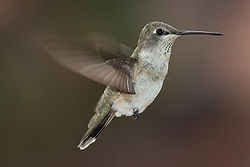
Did you know a hummingbird can fly backwards? A hummingbird flaps it wings so fast, about eighty times per second, that it can remain hanging still in the air. This allows it to fly vertically up- and downwards and as the only bird also backwards. However, this requires so much energy of the hummingbird that its heart has to beat about a thousand times per second. In order to sustain this incredible energy consumption it has to eat all day long. If the hummingbird cannot eat sufficiently for a week, due to heavy rain for instance, it will die of exhaustion.


Dries Persyn